
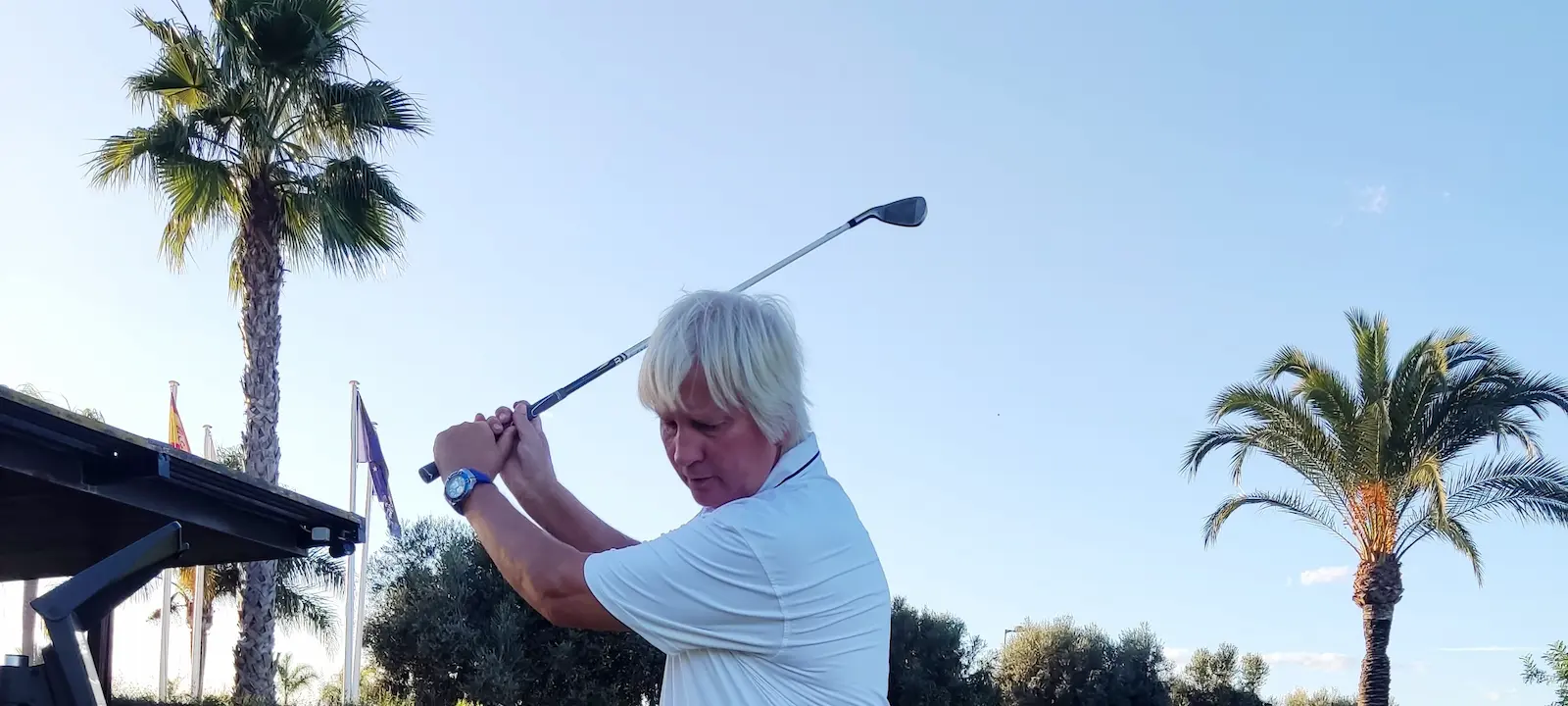
Are you thinking about taking golf lessons but don’t know how to choose the right instructor? Wondering if PGA certification really matters or if any experienced golfer can teach you well?
Choosing the right golf instructor can make the difference between frustration and real progress, between developing bad habits that are hard to correct or building solid fundamentals from the beginning.
As a professional PGA certificate with more than 35 years of experience as a golf teacher and 5 years in Murcia, I’ve seen many students arrive after investing time and money with unqualified instructors. The results are always the same: inconsistent technique, confused concepts and, worst of all, ingrained habits requiring months to unlearn.
In this complete guide, I’ll explain exactly what to look for in a golf instructor, why PGA certification matters, what questions to ask before committing, and how to evaluate if an instructor is truly right for you.
Why Not All Golf Instructors Are Equal
The reality is that anyone can advertise as a “golf instructor” or “golf coach.” There’s no regulation preventing it. But there are ENORMOUS differences between:
An amateur golfer who plays well and charges for “advice”
A professional without formal certification
A professional with generic certification
A certified PGA professional
The PGA Certification Difference
PGA (Professional Golfers’ Association) certification is the gold standard in golf instruction.
It’s not just a title. It’s a rigorous process including:
Exhaustive technical training:
Golf swing biomechanics
Applied anatomy and physiology
Movement analysis
Advanced technical correction
Equipment fitting
Teaching methodology:
Motor learning psychology
Effective communication
Adaptation to different levels
Pedagogical progressions
Expectation management
Complete game knowledge:
Official rules
Etiquette
Course strategy
Mental game management
Specific physical preparation
Mandatory continuing education:
Annual updates
Technical seminars
New methodologies
Teaching technology
Rigorous examinations:
Theory
Practice
Supervised teaching
Continuous evaluation
A PGA professional invests years and thousands of hours in training. It’s not comparable to someone who simply “plays golf well.”
The 10 Questions You MUST Ask Before Hiring
Before committing to a golf instructor, ask these questions. The answers will tell you everything you need to know:
1. “Do you have PGA certification? From which association?”
Why it matters: PGA certification is the guarantee of professional training.
Ideal answer: “Yes, I’m PGA [Spain/UK/USA, etc.], membership number [number], I can show you my accreditation.”
Red flag: Evasiveness, “I have years of experience but don’t need certification,” or “I’m in the process of certifying” (means they’re NOT certified).
2. “How many years have you been teaching golf professionally?”
Why it matters: Teaching experience (not just playing) is crucial.
Ideal answer: Clear number of years (minimum 3-5 years for solid experience).
Red flag: Confusing years playing with years teaching. “I’ve been playing golf for 20 years” is NOT the same as “I’ve been teaching golf for 20 years.”
3. “What is your teaching methodology?”
Why it matters: Shows if they have a structured system or improvise.
Ideal answer: Clear explanation of their process (initial assessment → diagnosis → progressive plan → follow-up → adjustments).
Red flag: “Depends on the student” without more details, or vague answers without clear structure.
4. “Do you regularly work with students at my level?”
Why it matters: Some instructors specialize in beginners, others in advanced players.
Ideal answer: “Yes, I regularly work with [beginners/intermediates/advanced], in fact [%] of my students are in your handicap range.”
Red flag: “I work with all levels” without being able to give specific examples of your level.
5. “Do you use video analysis?”
Why it matters: Video is an essential modern tool. Seeing your swing is educational and allows objective tracking.
Ideal answer: “Yes, I use video in all lessons with [specific software], I send you the analyses so you can practice with reference.”
Red flag: “I don’t need video, I see mistakes directly” (sign of outdated teaching).
6. “What does each lesson include?”
Why it matters: You should know exactly what you’re getting for your money.
Ideal answer: Clear breakdown (duration, video analysis, practice material, follow-up between lessons, etc.).
Red flag: Only mentioning duration without other details.
7. “How do you measure progress?”
Why it matters: Without objective measurement, you don’t know if you’re improving.
Ideal answer: Specific metrics (distance, accuracy, consistency, launch monitor numbers if applicable, handicap, round statistics).
Red flag: “You’ll see it in your game” without concrete metrics.
8. “Do you provide a practice plan between lessons?”
Why it matters: 90% of improvement happens in your personal practice. A good instructor guides you in this.
Ideal answer: “Yes, each lesson ends with specific documented exercises for you to practice correctly until the next session.”
Red flag: “Practice what we saw today” without documentation or structure.
9. “Do you know the courses where I regularly play well?”
Why it matters: Local knowledge allows applied teaching, not just driving range technique.
Ideal answer: “Yes, I know [course X] very well, I’ve been playing/teaching there for [years], I can give you specific strategies for those holes.”
Red flag: “The course doesn’t matter, technique is the same” (partially true, but local knowledge adds enormous value).
Signs of an EXCELLENT Golf Instructor
Beyond the questions, observe these indicators:
During the First Lesson or Consultation
✅ GOOD SIGN:
Asks you many questions about your goals, experience, playing frequency
Observes your swing from multiple angles before saying anything
Uses video from the first moment
Prioritizes 1-2 key changes, doesn’t overwhelm you with 10 things
Explains WHY for each correction, not just “how”
Ends with clear plan for next sessions
🚫 BAD SIGN:
Starts correcting immediately without evaluating
Tells you “everything’s wrong, we need to rebuild your swing from scratch”
Doesn’t use video or technology
Gives you 5-10 things to change at once
Uses technical jargon without explaining in simple terms
Doesn’t document anything
Communication and Teaching Style
✅ GOOD SIGN:
Adapts to YOUR way of learning (visual, verbal, kinesthetic)
Uses analogies and examples that click for you
Has patience when you don’t understand something
Celebrates small progress
Challenges you appropriately without frustrating you
🚫 BAD SIGN:
Teaches everyone the same without adapting
Gets frustrated if you don’t catch on quickly
Compares you negatively to others
Too technical without connecting with you
Too relaxed without challenging you
Technical Knowledge
✅ GOOD SIGN:
Can explain biomechanics in simple terms
Understands physical limitations (age, flexibility, injuries)
Updates knowledge with latest methodologies
Uses modern technology (video, launch monitor, etc.)
Knows equipment and can advise on fitting
🚫 BAD SIGN:
Teaches “as it’s always been done”
Doesn’t consider your individual physique
Uses only method/swing that works for them
Not up to date with teaching advances
Can’t explain WHY something works
Common Mistakes When Choosing an Instructor
Mistake #1: Choosing the Cheapest
The problem: Quality teaching has a cost. Certified professionals invest in training, equipment, insurance, facilities.
The reality: A cheap instructor who doesn’t improve you is MORE EXPENSIVE than an expensive professional who makes you progress.
The solution: Evaluate value, not just price. What’s included? What results do they promise?
Mistake #2: Choosing the Best Player
The problem: Being a good player ≠ being a good instructor. They’re different skills.
The reality: Many great players are terrible instructors. And vice versa.
The solution: Ask about TEACHING experience and results with students, not the instructor’s handicap.
Mistake #3: Not Trying Several Before Deciding
The problem: Instructor-student chemistry matters. You don’t know if you connect without trying.
The reality: The same instructor can be excellent for one person and mediocre for another depending on compatibility.
The solution: Take trial lessons with 2-3 instructors before committing to a package.
Mistake #4: Constantly Changing Instructors
The problem: Changing every 2-3 lessons doesn’t allow any method to work.
The reality: Technical changes require time (minimum 8-12 lessons).
The solution: Give an instructor at least 2-3 months before judging results.
Mistake #5: Not Communicating Clear Expectations
The problem: If the instructor doesn’t know what you want to achieve, they can’t design an adequate plan.
The reality: “Improve” is vague. “Lower handicap from 28 to 20 in 6 months” is specific.
The solution: Define SMART goals (Specific, Measurable, Achievable, Relevant, Time-bound).
What to Expect in the Learning Process
First 1-3 Lessons: Evaluation and Fundamentals
Complete analysis of your current swing
Identification of 1-2 key priorities
First adjustments (normally feels strange/uncomfortable at first)
Establishment of improvement plan
Normal: Feeling temporarily worse (you’re changing patterns) Not normal: Not understanding WHAT you’re changing or WHY
Lessons 4-8: Integration of Changes
Progressive work on corrections
Changes start feeling more natural
First signs of improvement in consistency
Possible addition of second element to work on
Normal: Ups and downs (good days and bad days) Not normal: Zero progress or growing confusion
Lessons 9-15: Consolidation
Changes integrated into natural swing
Measurable improvement in statistics
Work on more advanced elements
Greater autonomy in your practice
Normal: Visible and measurable improvement Not normal: Total stagnation without explanation
Beyond 15 Lessons: Refinement
Fine adjustments
Work on specific situations
Competition preparation if applicable
Maintenance and continuous improvement
Why Choose a PGA Instructor in Murcia and Alicante (Local Advantage)
If you’re going to play regularly in Murcia or southern Alicante, there are specific advantages to working with a local PGA instructor:
Course Knowledge
An instructor who knows La Finca, Roda, La Torre, etc., can:
Teach you specific strategies for difficult holes
Prepare you for typical conditions of each course
Give you specific green-reading tips
Help you with club selection according to local layout
Local Climate Adaptation
Murcia has specific conditions:
Frequent wind (ball flight management)
Fast greens in summer (putting technique)
Firm ground (approach adjustments)
A local instructor teaches you adapted to these real conditions.
Continuity
If you live or visit Murcia or south of Alicante regularly:
Long-term follow-up
Consistent lessons in same place
Progress documented year after year
Solid instructor-student relationship
How We Work at Gardarsson Golf School
Let me explain how I apply these principles in my teaching:
My Teaching Philosophy
1. Evaluation before action I don’t correct anything without first understanding your swing, your goals, your limitations.
2. Simplicity over complexity One well-executed change is worth more than ten mediocre changes.
3. Education, not just instruction I explain the WHY. I want you to understand your swing, not depend on me.
4. Objective measurement We use video, data, statistics. Not vague “feelings.”
5. Guided practice Each lesson ends with a specific plan of what to practice and how.
What’s Included Working With Me
✓ Official PGA certification – Verifiable membership number ✓ 35+ years experience – Hundreds of students at all levels ✓ Professional video analysis – Specialized software, recordings you take with you ✓ Expert local knowledge – 5 years teaching on Murcia and Alicante courses ✓ Structured methodology – Proven system, not improvisation ✓ Lessons in your language – Spanish, English, German, Icelandic ✓ Practice materials – Documented exercises, reference videos ✓ Continuous follow-up – Available via WhatsApp between lessons ✓ Flexibility – Individual, group, clinics, playing lessons
The Decision is Yours (But Make It Informed)
It doesn’t matter if you ultimately choose to work with me or another instructor. What matters is that you make an INFORMED decision.
Use the questions from this guide. Observe the signs. Trust your instinct after evaluating objectively.
A good golf instructor is an investment in your game that will pay dividends for years. A bad instructor is wasted time and money, and bad habits to undo.
Take the time necessary to choose well.
Looking for a Certified PGA Instructor in Murcia or Alicante?
If you’re looking for professional golf lessons in Murcia / Alicante with:
✓ Official PGA certification
✓ Proven experience (35+ years)
✓ Structured methodology
✓ Expert knowledge of local courses
✓ Teaching in your language
I’d love to talk with you.
👉 CONTACT FOR FREE INITIAL CONSULTATION 👈
No pressure. No mandatory packages. Just an honest conversation about your goals and how I can help you.
Your golf deserves certified professional teaching.